The Current Monetization Stack is Broken
The game has fundamentally changed. The infrastructure most studios rely on to monetise it hasn't kept pace - and the consequences are starting to show.
Everywhere you looked in 2025, D2C was the story.
Apple, Google, Epic, alternative app stores, regional rulings - it dominated headlines, conference agendas, and studio payment strategy conversations in equal measure.
And yet, despite all that noise, most of the conversation has been about the wrong thing.
The dominant message that D2C is primarily about recovering the 25-30% that platforms take is not just incomplete. It has side-tracked the conversation and might have even distracted studios from the more fundamental shift in gaming.
The monetisation stack most studios rely on today was built for a different era of games. The question is whether it can serve the era we're in now.
The Era It Was Built For
For most of the industry's history, the model was relatively straightforward.
A game launched. Players bought it, or bought things in it. Platforms processed those transactions, took their cut, and studios moved on to the next release or the next content drop.
Monetization, in that world, was transactional by design. It happened at regular and planned moments - the purchase, the DLC, the season pass.
The platform sat between the studio and the player, handling payment infrastructure, distribution, and compliance.
Studios accepted that arrangement because it worked well enough, and the operational simplicity it offered had real value.
That world still exists in some parts of the industry. But it no longer describes where the most significant growth is happening.
The Era We're Actually In
Games today are not products. They are long-lived platforms with evolving economies, player communities, creator layers, and monetisation tails that stretch across years - not purchase moments.
Cross-platform play is increasingly becoming standard.
UGC and creator ecosystems are becoming core to how the biggest games - like Roblox, Fortnite, Minecraft, Hytale, and more - grow and retain players.
Continuous content, seasonal economies, and live-service loops have replaced the box-and-done release model for a growing number of studios, from AAA to mid-size indie.
What this means is that monetisation is no longer a discrete event. Instead, it is a system - one that is expected to operate 24/7, across regions, platforms, player segments, and payer preferences simultaneously and seamlessly.
All while continuously adapting to how the game and its community evolve.
The stack most studios are running was not designed for that. It was designed to process transactions.
The gap between what that stack was built to do and what studios now need it to do is widening - and that gap is where revenue is being left on the table.
Why the 30% Framing Is the Wrong Lens
The fee-reduction narrative is not entirely wrong. There are real savings available. But the reality is more nuanced than the headlines of 2025 suggested:
- Apple and Google still take commissions in most regions.
- Payment processing costs apply regardless of channel.
- Vendor partnerships introduce their own fee layers.
The result: What was initially framed as reclaiming 30% has, in practice, turned out to be something more conditional.
And if fee reduction is the primary reason for studios adopting D2C, the business case falls apart the moment those savings are smaller than expected.
Or if platforms, like Google, change their fee structure.
The studios getting the most out of D2C came in with a different question. Not "how much will we save?" but "what does owning this relationship actually unlock?"
The Real Shift: Who Owns the Player Relationship
Underneath the fee conversation is a more consequential structural change - one that has been building quietly for years.
Historically, the platform sat between the studio and the player at the point of transaction. That meant the studio had limited visibility into who was buying, how they were buying, what made them convert, and what brought them back.
Behavioural data, purchase history, and communication channels were largely locked behind platform gatekeeping.
And this is a strategic blindspot because in a live-service model, the player relationship is the revenue model.
Retention drives LTV.
LTV drives the economics of live service.
And retention, at its core, is a function of how well a studio understands, reaches, and responds to its players over time.
Without direct access to the player - without owning that relationship - studios are operating with a structural blind spot in their most important business system.
D2C changes that but not because it saves fees.
But because it gives studios something they have historically not had full access to: direct, unfiltered connection to the comunity playing their games.
That is the unlock. And it compounds over time in ways that wasn't possible in the platform era.
A Systems Problem, Not a Payments Problem
What makes this genuinely hard is that most studios recognise the opportunity in principle but underestimate what it takes to execute it well.
D2C is not a payments problem.
Dropping a webstore and connecting a payment processor does not make you a D2C-capable studio.
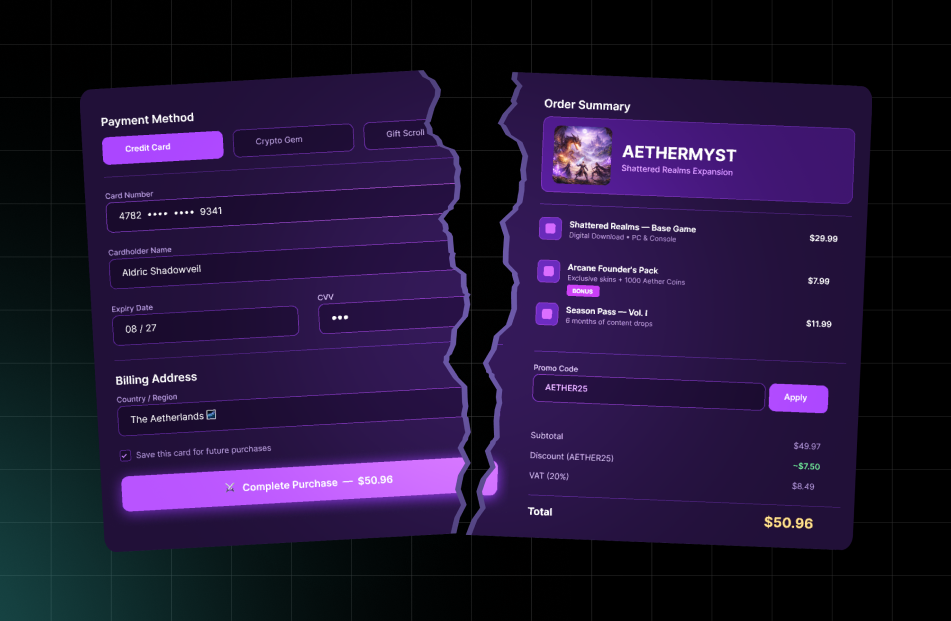
Rather the player experience around payment - the trust signals, the localisation, the payment methods available, the purchase flow - is now part of the product experience.
Players make judgements about a brand at the checkout just as they do while playing.
At the same time, monetisation in a live-service model is not a "set it and forget it" decision.
It demands continuous iteration:
- Global expansion adds complexity
- Player expectations shift
- What converts well in one region does not necessarily translate to another
The operational surface area of running D2C properly grows as the game grows.
This is a systems problem. The infrastructure most studios have inherited was not built to handle it at that level of sophistication or at that scale.
And patching a transaction-era stack with modern expectations is not a sustainable approach.
What This Means for Studios Now
The regulatory and legal shifts of the past two years have opened the door. Apple, Google, regional rulings, alternative stores - these changes are real, and they represent real opportunities for studios that appreciate the value of taking ownership of the player relationship into their own hands.
The opportunity is not in the fee saving.
It is in what a studio can do when it can see, reach, and serve players directly, optimise the commerce experience as part of the game product, and build monetisation systems that compound over the full lifecycle of the game rather than at discrete purchase moments.
The studios that will come out ahead are not the ones who moved earliest to avoid platform fees.
The stuios that win in the new era are the ones who recognised that D2C is a growth engine - and built infrastructure capable of running it properly.