How Player Spending Is Changing in 2026 - Gamesbeat Summit Recap
Growth in games is no longer a funnel. It is a relationship. At Gamesbeat Summit 2026, a panel on player data and monetization made the shift concrete, and the implications for studio revenue are significant.
How Player Spending Is Changing in 2026 - Gamesbeat Summit Recap
For most of the last decade, studios talked about growth as a funnel.
Acquire, convert, retain, repeat.
In 2026, that model is breaking down. Growth is defined by owning and building the direct studio and player relationship.
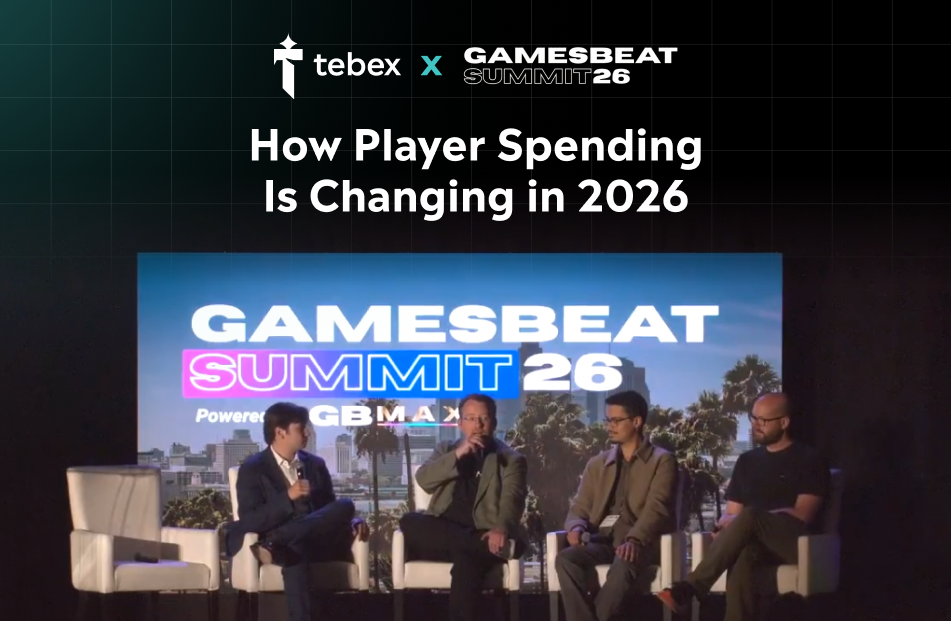
The Tebex-sponsored panel at Gamesbeat Summit examined that shift across data, live operations, and game development.
Below is the full panel recording and takeaways with direct consequences for how studios think about monetization infrastructure.
Players are spending more deliberately
In 2026, the first purchase players make is getting delayed.
They now build confidence before they commit, asking whether a game is worth their time before they decide it is worth their money.
Time investment precedes financial investment. The two are linked.
This means the value of social proof at the moment of decision is more important than ever.
Creator codes, referrals, and visible signals that other players are already invested help close the confidence gap and convert hesitation into a first purchase.
For studios, the path to first spend is no longer a checkout problem.
It is a trust problem, and the commerce layer has to support the mechanics that build that trust.
Buy Now, Pay Later is reshaping high-value purchases
One of the clearer shifts named on the panel was the move toward buy now, pay later for higher-value purchases.
In much of the West, BNPL still carries debate about whether it belongs in games. In other regions, the question was settled long ago.
In Brazil, for example, paying in card installments has been normal for nearly a decade.
The framing that matters is not novelty. It is catch-up.
With gaming’s value as a form of escapism, players want to enjoy themselves while feeling they’re in control of their spending.
Studios that treat localized payments and flexible billing as core infrastructure, rather than a regional afterthought, are positioned to capture spend that a single-method checkout would lose.
The metrics that matter are the ones you can read today
A recurring theme was the speed of measurement.
Studios have long anchored to 30-day retention and long payback windows. Some user-acquisition models stretched payback to 180 days, then to 720, before the market pulled those windows back in when the bets stopped paying off.
But in a market moving at the speed of UGC and AI, making a change and waiting weeks or years to learn whether it worked is no longer viable.
Studios need to read impact within days, using early signals as modeled proxies for long-term outcomes. The ones that iterate fastest, guided by data they can actually act on, will outpace the ones waiting on slower reporting cycles.
Monetization is part of that loop. The ability to test pricing, offers, and checkout changes and read the result quickly is now a competitive advantage, not a reporting nicety.
Loyalty is a journey, not a moment
The most striking observation was how loyalty compounds across games.
Players grow up inside gaming. Someone who started in Minecraft graduates to Rust, Ark, or Garry's Mod, then to roleplay servers, then to buying the next title from a studio they have followed for years.
Hytale is the clearest example.
The studio grew out of a modded server community, was acquired, was shut down, and was bought back by its original founders.
Through all of it, the player base stayed. That commitment translated into commercial reality: pre-orders alone, before release day, secured the studio for two years.
This is the real argument for owning the player relationship. When a studio's connection to its players runs through an intermediary, that loyalty is harder to see, act on, and monetize on the studio's own terms.
What this means for studios
Monetization is moving closer to the player relationship and further from the one-time transaction.
- Intentional spending rewards trust.
- Flexible payments capture revenue that rigid checkout loses.
- Fast measurement compounds into faster iteration.
- Loyalty, owned directly, becomes a durable revenue base.
The gaming funnel of yesteryear framed players as a flow to be converted. Today's framework positions the studio-player relationship as where studios earn and keep a community.
In 2026, the studios that build their monetization around the community - and not the other way around - are the ones that will compound.
FAQ
How is player spending behavior changing in 2026?
Players are spending more deliberately. First purchases are increasingly delayed as players build confidence that a game is worth their time before committing money. Social proof, creator codes, and referrals help close that confidence gap at the point of decision.
Why is buy now, pay later (BNPL) growing in games?
BNPL is being adopted for higher-value game purchases because it lets players enjoy games while controlling their budgets. In regions like Brazil, paying in card installments has been standard for nearly a decade, and Western markets are now catching up.
What metrics should game studios prioritize for monetization?
Studios should prioritize metrics they can read within days, using early-retention and early-engagement signals as modeled proxies for long-term outcomes. The ability to measure and act quickly matters more than waiting on 30-day or longer reporting cycles.
Why does owning the player relationship matter for monetization?
Player loyalty compounds across games over years. When a studio owns its player relationship directly rather than through an intermediary, it can see, act on, and monetize that loyalty on its own terms. Hytale's pre-orders secured the studio for two years before release, driven by a player base built through years of community engagement.
What is a Merchant of Record in gaming?
A Merchant of Record is the entity legally responsible for selling to the player, handling global payments, localized checkout, fraud protection, chargebacks, tax, and compliance on the studio's behalf. Tebex operates as a Merchant of Record purpose-built for games and UGC economies.