Chargeback, disputes, and the new cost of running a mobile game
Google's announcement that developers will be responsible for purchase chargeback means a $5 microtransaction can now cost you $25–30 to dispute. But the transfer of payment risk from platforms to developers is even more crucial as an industry trend.
The status quo has remain unchanged for years: mobile platforms absorbed a big chunk of payment complexity on behalf of developers. Fraud protection (to a large degree), dispute handling, and chargeback liability all sat with the platform.
Google’s announcement this month is changing all that.
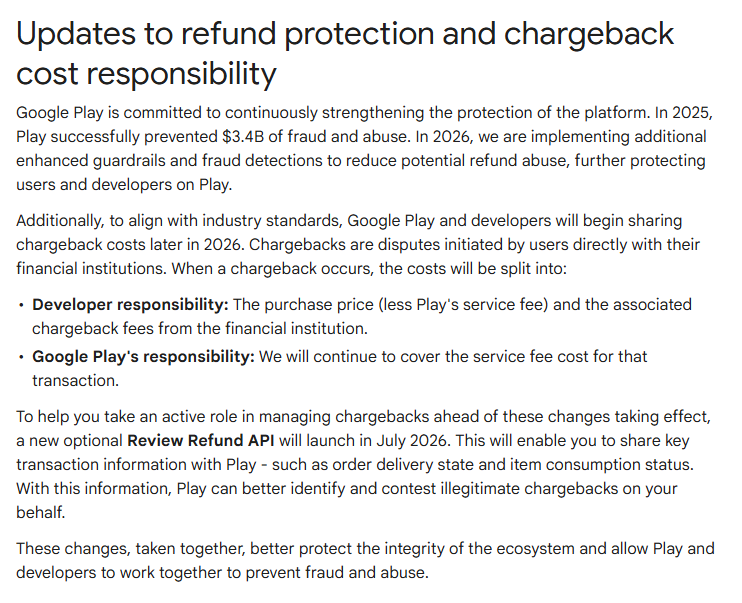
Later in 2026, Google Play will begin holding developers responsible for disputed purchase amounts and the associated chargeback fees.
The direct implications on operational demands are real. But the more important story is structural.
What Google’s New Policy Covers
In addition to covering chargebacks and the associated fees, Google is also introducing a Review Refund API that gives developers the ability to submit transaction-level evidence. See screenshot from Google’s site below.
The bigger story is Google’s decision represents a gradual shift in how platforms are choosing to allocate payment risk.
As app store economics evolve and margins get thinner, legacy platforms are becoming less willing to absorb the operational cost of fraud, disputes, and payment liability.
In other words, the same risk as always still exists, the platforms are simply relocating it to the game makers.
And for studios running live-service games, subscriptions, or high-volume in-game economies, that relocation has direct consequences.
Chargebacks: an operational domain, not a data collection problem
The direct focus in Google’s announcement is focused on evidence gathering to combat chargebacks:
- Submit better data
- Track item delivery
- Log consumption events
That framing is not wrong (you certainly need transaction data when contesting disputes) - but reducing this to a data problem shifts the focus from the bigger hurdle: the operational challenge.
In live-service game economies, chargebacks are structurally different from retail disputes. Virtual goods are consumed the moment they are delivered. Inventory states change continuously. Players transact across multiple devices and platforms. Subscriptions span different payment methods and billing cycles.
These games' economies involve user-generated content, gifting mechanics, and cross-player interactions that complicate the transaction record significantly.
Winning disputes in this environment does not just require having the right data. It requires having the systems in place to capture, organize, and surface that data operationally. At any moment and at scale.
And it means there is an always-on function in the studio responsible for handling it across every transaction type your game supports. It is an infrastructure problem.
The real cost of fragmented payment stacks
Some studios rely on a combination of platform-native billing, third-party payment processors, separate fraud tooling, manual dispute workflows, and independent tax and compliance providers.
While each layer solves one problem in isolation, it requires expertise and time to bridge the inherent fragmentation.
Studios without unified payment infrastructure face a harder version of the dispute challenge. Because the data they need to fight a chargeback is spread across disconnected systems. A $5 microtransaction can now cost you $25–30 to dispute - and that's before accounting for the staff time to reconstruct the evidence manually.
The studios best positioned to navigate this shift are the ones that already have consolidated monetization infrastructure: systems that connect payment processing, fraud detection, fulfillment tracking, and dispute management in a way that makes transaction-level evidence accessible without manual reconstruction every time a dispute lands.
What this means for mobile-first commerce infrastructure
A payment provider that moves money from A to B and offers a webstore is not the same as a monetization partner that owns operational risk.
Google's change will put the spotlight on what payment providers actually cover and their chargeback dispute process. If they even offer one.
Many providers manage payments but shift fraud liability, compliance requirements, and dispute handling onto the studio.
When platforms absorbed some of that risk, things worked well. They might not anymore if the studios are the ones on the hook.
The question studios should be asking their payment vendors is not "do you support Google Play alternative billing" but "who owns the chargeback when it arrives, and what happens when it does?"
Monetization infrastructure built for this moment, and the future
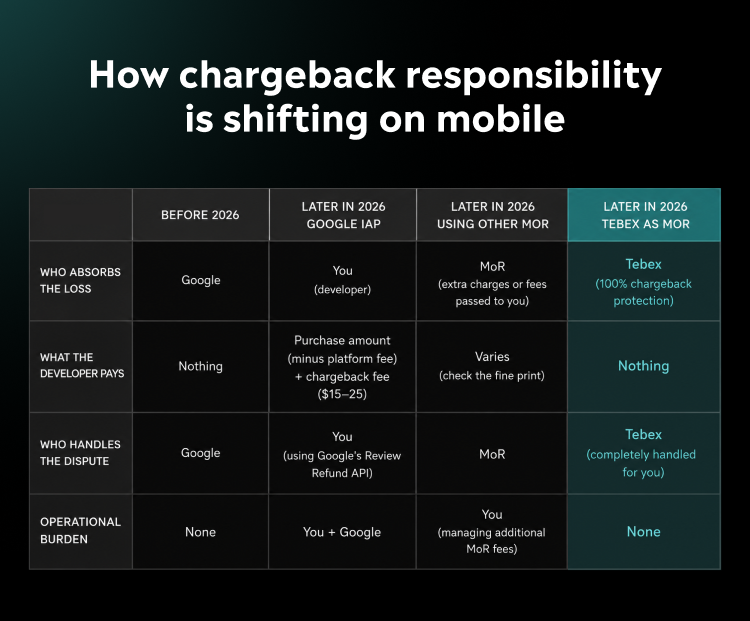
Tebex operates as a Merchant of Record (MoR) for all its partners, meaning Tebex accepts much of the payment liability on behalf of studios and developers.
When a chargeback arrives, Tebex is the legal merchant on the hook for managing the dispute, not the developers. In fact, Tebex offers 100% chargeback protection to studios so they never need to worry about handling chargebacks.
Tebex manages the dispute, absorbs the loss where appropriate, and handles the operational overhead that would otherwise fall to the studio's team.
Google's chargeback policy is not the end of this shift. It is the beginning of a bigger reorientation about what studios need from their monetization partners.
The studios that ask that question now will be better positioned than the ones who ask it after the first disputed charge lands on their books.